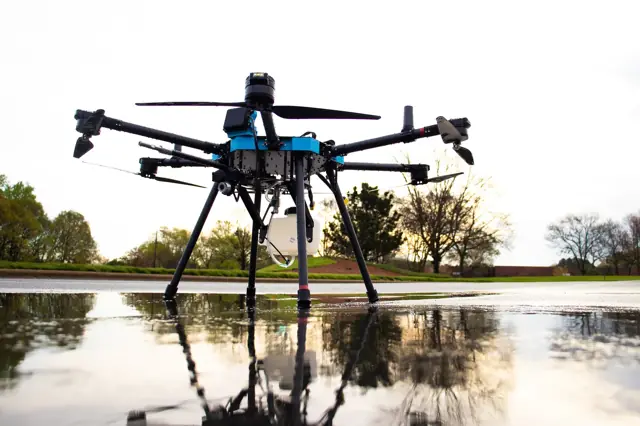

Mid rise window cleaning is awkward because the glass is too high for ladders and water-fed poles, yet the building is often too small to justify a swing stage. The main options are boom lifts, rope access and drones. Drones wash the glass from the air while the pilot stays on the ground.
The awkward middle heights
Low buildings are simple. A cleaner with a pole or a ladder can reach every pane. Towers are complicated but well served, because they are built with roof anchors and rigging points for suspended platforms.
Mid-rise buildings fall between the two. Think of the apartment block of five or six floors, the medical office with a glass stair tower, or the hotel beside the highway. The top floors are out of reach from the ground, and the roof often was never designed to hang equipment from.
The result is familiar to many owners. The lower floors get cleaned on a regular route, and the upper floors wait until someone finds a way up.
Ladders and water-fed poles
Ladders stop being practical after the first couple of floors. Each move takes time, the footing has to be right and the fall risk climbs with every rung.
Water-fed poles go higher. They pump purified water up a telescoping pole to a brush. They work well on lower floors, but the longer the pole, the heavier and harder it is to control. At the top of its reach, the operator is steering a brush they can barely see. On a mid-rise, poles usually handle the bottom of the building and leave the top unfinished.
Boom lifts
A boom lift puts a cleaner in a basket right at the glass, which gives a close, hands-on clean. The limit is the ground under it. A lift needs firm, fairly level footing and room to drive and swing.
Many mid-rise sites do not offer that. Gardens, soft lawns, retaining walls, underground parking slabs, patios and narrow lanes all get in the way. A lift on a public sidewalk or street may need a permit and traffic control. The side of the building that faces a courtyard may be unreachable altogether.
Swing stages and rope access
A swing stage is a platform hung from the roof on cables. It is the standard on tall towers, where the setup effort is spread across a lot of glass. On a mid-rise, the same setup serves only a few floors. If the roof has no certified anchors or the parapet cannot take the rigging, it may not be possible at all.
Rope access has a smaller footprint. Technicians descend the face on ropes. It still depends on sound anchor points on the roof, and it puts people over the edge of the building.
How drones fill the gap
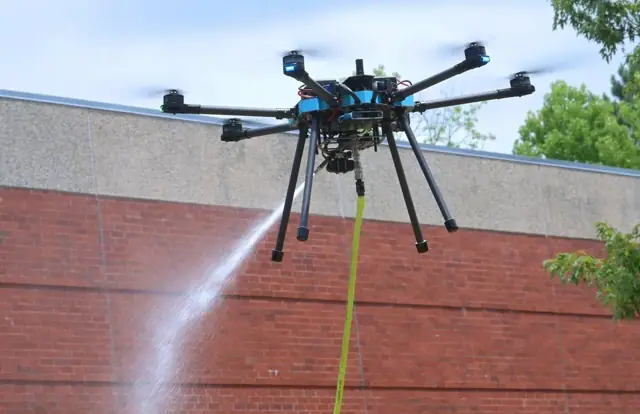
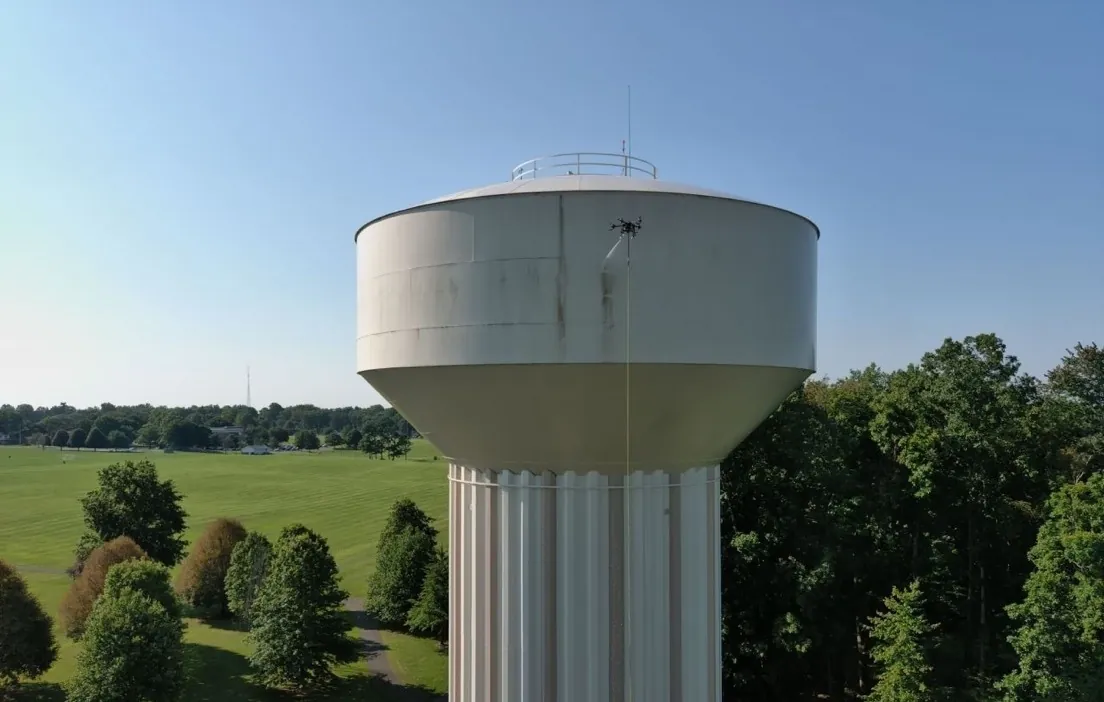
A drone does not need anything from the roof or the ground beyond a clear zone below the work. It flies up the face, washes the glass with deionized water and a safe cleaning solution, and moves on. The pilot stays on the ground.
That suits the features that make mid-rise buildings hard.
The purified water matters here too. It dries without mineral spots, so the glass does not need to be squeegeed by hand at height.
- No anchors, davits or roof access needed.
- No heavy machine on lawns, pavers or parking slabs.
- Courtyards and sides with no vehicle access can be reached from the air.
- Setup is a cordon below the work area, not a build.
- Glass above canopies, lower roofs and entrance features is reachable.
Where a drone is not the answer
Drones have limits, and a fair comparison includes them. Wind and rain delay flights. Heavy staining that has been left for a long time may need a second pass, and some jobs call for hand work, such as scraping paint or sealant off glass after construction. A person in a lift is better for that.
Buildings near airports may be in controlled airspace, where the operator needs authorization first. Trees or wires close to the facade can block a section. Many properties end up with a mix: a drone for the upper floors and poles for the ground-level storefronts.
Choosing for your building
Start with three questions. What can the roof support? What is the ground like on each side? How much disruption can tenants and neighbors accept? The answers usually narrow the field quickly.
Drone Sky Cleaners quotes each building after looking at its height, glass area and access, and takes requests across Canada and the United States.
Common questions
What counts as a mid-rise building?
There is no single definition, and local codes vary. In everyday use it means a building taller than a walk-up but shorter than a tower, typically somewhere from about four floors to around a dozen.
Can one building use more than one cleaning method?
Yes, and many do. A common split is a drone for upper floors and hard-to-reach sides, with ground crews handling street-level glass, doors and entrance details by hand in the same visit.
Does a mid-rise need roof anchors for drone cleaning?
No. The drone takes off from the ground and nothing is attached to the building. That makes it an option for older mid-rises whose roofs were never fitted with anchors or have anchors that are out of certification.