
Drone cleaning in Texas depends on the city. Dallas buildings collect dust and pollen, Houston adds Gulf humidity and algae, Austin has construction dust and cedar pollen, and San Antonio has hard water and limestone dust. Across the state, summer heat pushes work to early morning and spring storms move dates.
One state, several climates
Texas is too big for one cleaning rule. The Gulf coast is humid and salty. North Texas is drier, windier and prone to spring storms. Central Texas sits on limestone hills. What lands on your building, and how fast, depends on which part of the state it stands in.
The four largest metros show the range well.
Building stock varies as well. The big downtowns are full of mirrored and tinted glass towers, while the suburbs spread out into low office parks, distribution centers and retail strips. Each type collects dirt in its own way.
Dallas, Houston, Austin and San Antonio compared
Each city has its own main problem. Knowing yours helps you describe the building when you ask for a quote.
- Dallas: wind carries dust and pollen onto the glass towers of Downtown, Uptown and the suburban office parks. Spring hail and thunderstorms leave mud spatter and debris.
- Houston: humidity from the Gulf feeds algae and mildew on shaded walls. Buildings near the ship channel and the freeways pick up an oily film.
- Austin: years of building mean construction dust on nearly every downtown tower. Winter brings heavy cedar pollen from the hills to the west.
- San Antonio: hard water from irrigation spots low glass, and limestone dust settles on ledges. Stone and stucco are common alongside newer glass.
Scheduling around the heat
Texas summers are long and hot. Glass in full afternoon sun gets hot enough that cleaning solution can dry before it is rinsed, and dried solution leaves marks.
The answer is timing. Crews start at first light, wash the sunny elevations while they are still cool and follow the shade around the building. On large towers the work may be split across several mornings. Fall, winter and early spring are more forgiving, and mild winters mean most of the state can be washed all year.
Heat affects the crew and the equipment as well. Batteries and people both need breaks in high temperatures, so a summer job can take more visits than the same job in the fall.
Dust, pollen and what follows a storm
Dry dust on its own is not hard to rinse. The trouble starts when a light shower wets it. The rain turns dust into streaks, then dries, and the streaks set in the sun. This is why windows often look worse after a brief rain.
Spring is storm season across much of the state. Strong storms can bring hail, high wind and blowing debris. Drone flights stop well before a storm cell arrives. Afterward, many owners want a rinse to clear mud and leaf litter from glass and ledges.
A drone can also help you look. Before-and-after photos show the facade and roof up close, though they are not a substitute for a proper damage inspection.
Airspace and Texas drone law
Commercial drone work in the United States is flown under FAA Part 107: a certified remote pilot, a registered drone and authorization in controlled airspace near airports.
Texas cities have plenty of that airspace. Dallas has Love Field close to the city center and DFW to the west. Houston has Hobby and Bush Intercontinental. Austin has Austin-Bergstrom, and San Antonio has its international airport plus large military airfields. Authorization near these is usually requested through the FAA's LAANC system.
Texas also has its own state law on drone use, including limits on capturing images and on flying over certain facilities. A professional operator plans with both sets of rules in mind. Rules change, and operators must check the current rules.
How a Texas job is handled
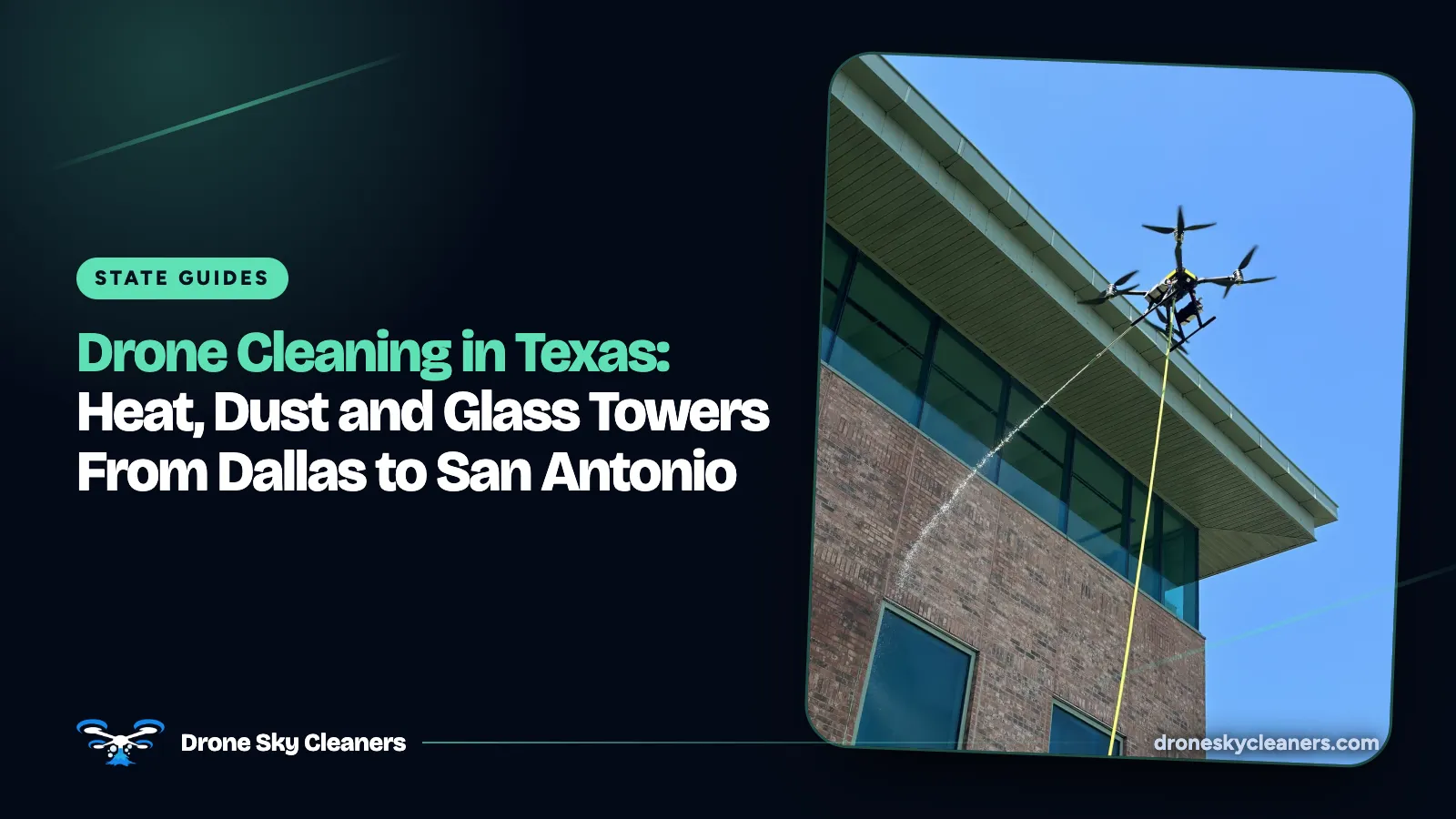
Drone Sky Cleaners takes requests across Texas. Work is carried out by its own crews or a local Drone Sky franchise partner. The drone washes windows, facades and roofs with deionized water and a safe cleaning solution while the pilot stays on the ground. No scaffolding, swing stages, rope access or lifts are used.
The process is the same in every city: pre-inspection, flight planning, cordoning off the area below, cleaning, final inspection and before-and-after photos. Quotes are priced per building after a look at its height, glass area and access.
Be realistic about limits. Wind stops flights, baked-on mineral marks may need a second pass, and some sites near airports need extra lead time.
When you ask for a quote, name the city and say what is nearby, such as a freeway, a rail line or an active building site.
Related pages
- Drone Cleaning Texas
- Drone Cleaning Dallas
- Drone Cleaning Houston
- Drone Cleaning Austin
- Drone Cleaning San Antonio
Common questions
What time of year is easiest for exterior cleaning in Texas?
Fall through early spring is usually the most comfortable, with cooler glass and steadier weather. Summer work is still possible with dawn starts. Late spring needs flexible dates because thunderstorms and hail can interrupt plans at short notice.
Can a drone remove hard water spots from low windows?
Light spotting often rinses away with cleaning solution and purified water. Marks that have baked on for a long time may need a second pass or hands-on treatment. Redirecting the sprinklers that cause them is the lasting fix.
Does Texas have special rules for drone cleaning companies?
Texas has state drone laws that sit alongside the federal FAA rules, mostly about images and sensitive sites. They do not prevent exterior cleaning, but an operator should know them. Ask how they handle compliance for your location.