
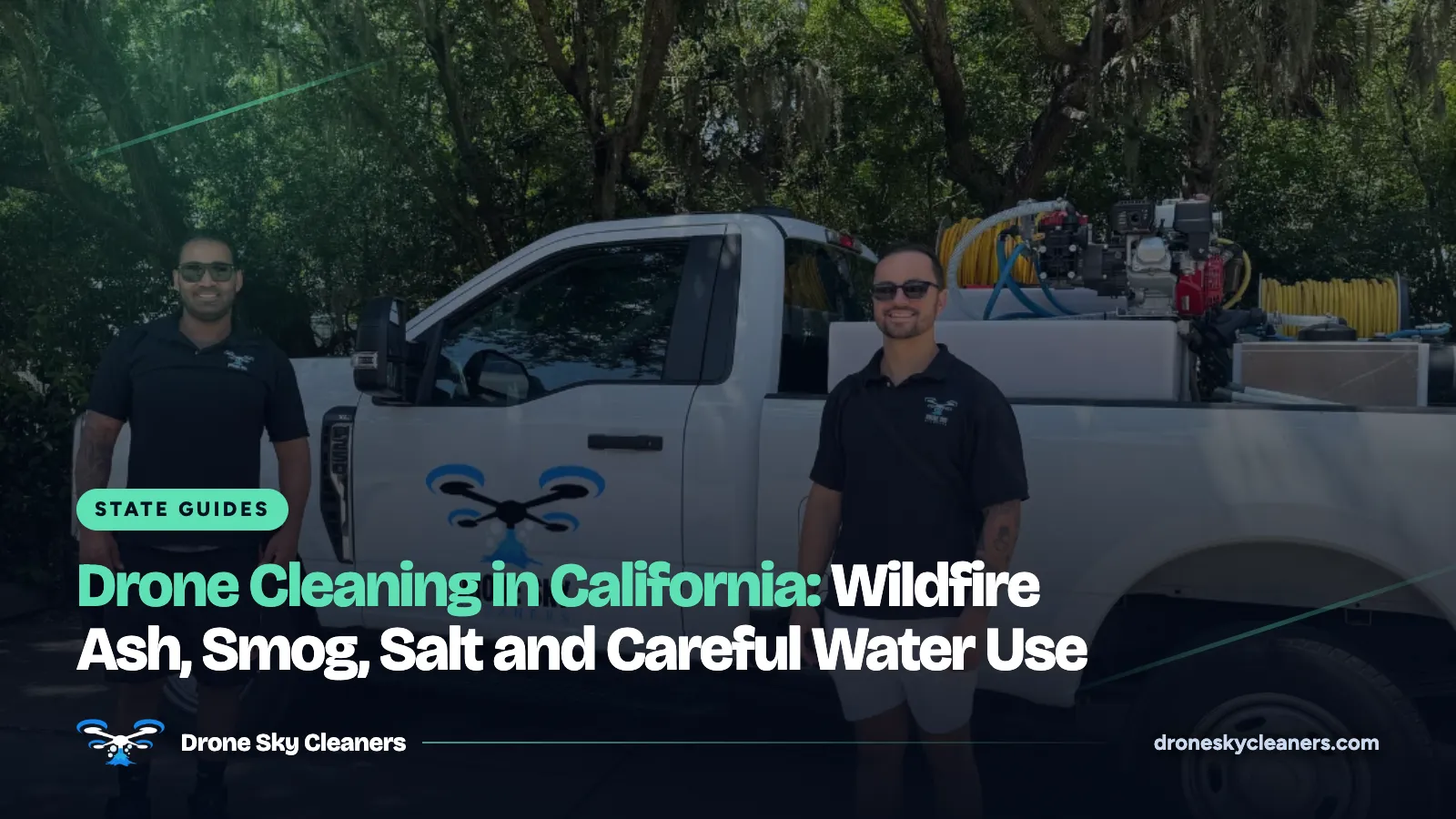
Drone cleaning in California has to deal with wildfire ash, smog film and coastal salt that build up through long dry months with little rain to rinse them. Good practice means gentle washing with purified water, careful water use, keeping runoff out of storm drains and getting FAA authorization near the state's many airports.
Months without a rinse
Most of California gets its rain in winter and very little the rest of the year. For a building, that means months of dry weather when everything that lands on the glass stays there.
What lands depends on where you are. The coast gets salt. The big basins get smog. And in fire season, large parts of the state get ash. Many buildings get all three.
Winter rain does not fix it either. The first storm of the season wets months of dust and leaves the glass streaked.
Wildfire ash and soot
Smoke from a wildfire can travel a long way. When it settles, it leaves fine gray ash and darker soot on windows, sills, roofs and solar panels, even on buildings far from the fire itself.
Ash should be handled gently. It is gritty, so wiping it dry can scratch glass and coatings. It can also turn into a stubborn paste when it gets slightly damp from fog or dew.
A drone wash is a good fit because nothing touches the surface. A safe cleaning solution loosens the film and a deionized water rinse floats the particles away. After a heavy smoke event, a second pass may be needed. It is also sensible to wait until the smoke has cleared, or the building will be coated again within days.
Coastal salt and the marine layer
From San Diego to San Francisco, the marine layer rolls in overnight as low cloud and fog. It carries salt and leaves surfaces damp each morning. When the sun burns it off, the salt dries in place.
Glass towers in downtown San Diego, Santa Monica, Long Beach and along the San Francisco waterfront all see this cycle. Because summer brings no rain, the film builds layer on layer. The marine layer also affects flights: if low cloud hides the upper floors, that part of the job waits until it lifts.
Smog film in the basins and valleys
Los Angeles, the Inland Empire and the Central Valley trap air between mountains. Traffic and industry leave a fine, slightly oily film on glass. It is less visible than ash, but it dulls windows and holds dust.
Buildings beside freeways get the most. So do the faces that look toward ports and rail yards. This kind of film needs cleaning solution to break it down. Water alone tends to smear it.
Using water with care
Californians pay attention to water, and so do their cities. During dry years, local agencies may limit outdoor water use. Many places also have rules about what can flow into storm drains, since those usually lead straight to creeks and the ocean. The details differ from one city and water district to the next.
A responsible wash plan takes this seriously.
- Use a targeted spray that puts water on the surface, not into the air.
- Choose a cleaning solution that is safe for the building and its surroundings.
- Look at where runoff will go during the pre-inspection, and protect drains where local rules call for it.
- Ask the operator what local water and runoff rules apply to your address, and check them yourself as well.
Airspace near the big airports
Commercial drone work is flown under FAA Part 107, with a certified remote pilot, a registered drone and authorization in controlled airspace near airports. That authorization is usually requested through LAANC.
California has many busy airports close to dense districts. San Diego International sits beside downtown. Los Angeles has LAX plus Burbank, Long Beach and John Wayne in Orange County. The Bay Area has San Francisco, Oakland and San Jose within a short distance of each other. Rules change, and operators must check the current rules.
Requesting a wash in California
Drone Sky Cleaners takes requests across California. Work is carried out by its own crews or a local Drone Sky franchise partner. The pilot stays on the ground and no scaffolding, swing stages, rope access or lifts are used.
Each job includes pre-inspection, flight planning, cordoning off the area below, cleaning, final inspection and before-and-after photos. Quotes are priced per building after looking at its height, glass area and access.
Tell the planner about recent smoke, nearby freeways and how close the building is to the ocean. Those three details explain most of what is on the glass.
Related pages
- Drone Cleaning California
- Drone Cleaning Los Angeles
- Drone Cleaning San Diego
- Drone Cleaning San Francisco
- Drone Cleaning Sacramento
Common questions
How soon after a wildfire should a building be washed?
Once the smoke has cleared and ash has stopped falling. Washing too early means the building is coated again. Leaving ash for many weeks is not ideal either, since damp mornings can turn it into a film that is harder to remove.
Does drone cleaning use a lot of water?
A drone sprays water directly onto the surface in a controlled pattern, so little is lost to overspray. The amount still depends on the size of the building and how dirty it is. Ask about water use when you request a quote.
Can solar panels be washed at the same visit as the windows?
Often they can. Ash and dust settle on rooftop panels as well as on glass, and a purified water rinse suits both. Mention the panels when you ask for a quote so they are included in the flight plan.