
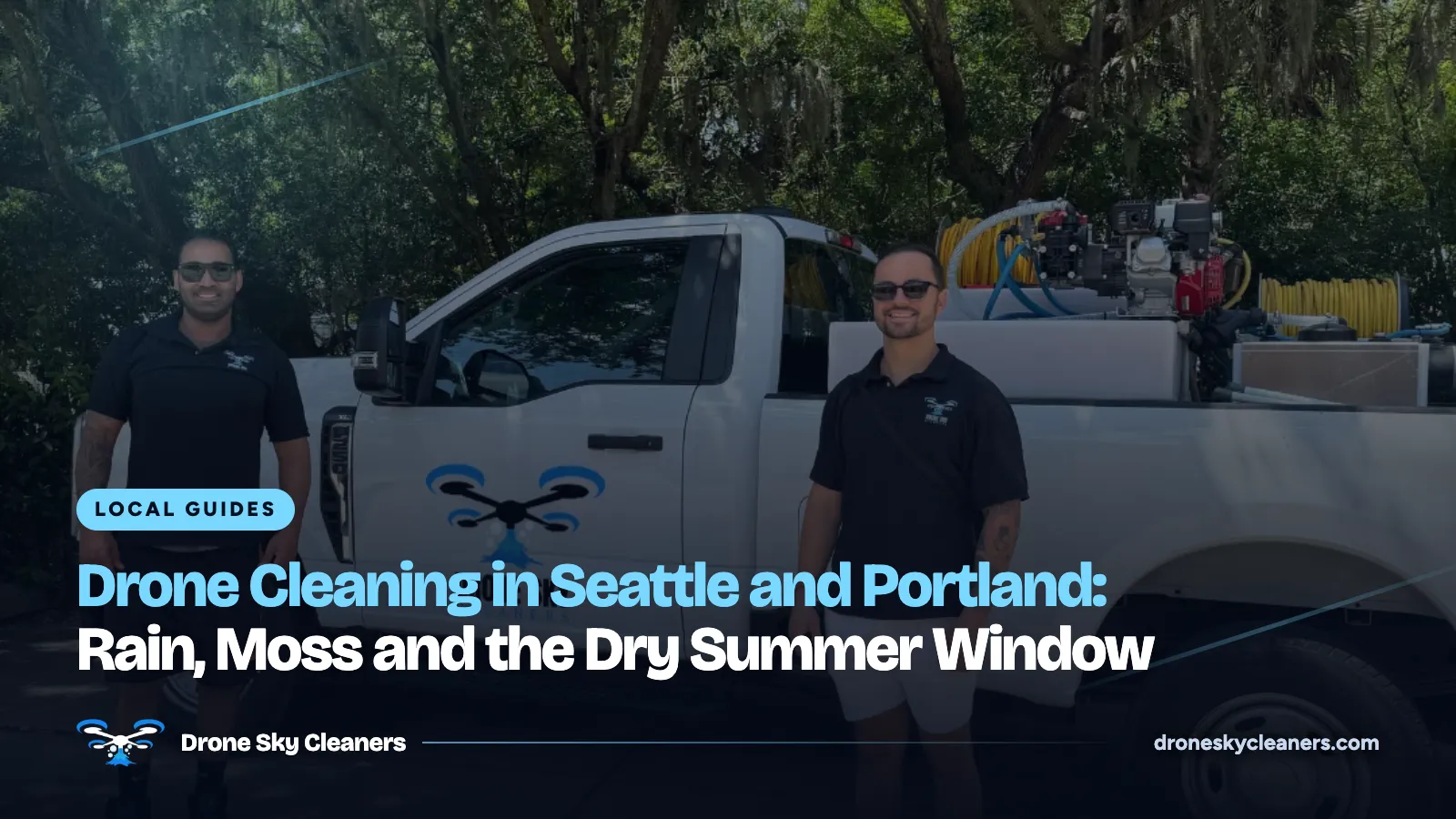
Drone cleaning in Seattle and Portland focuses on moss, algae and the gray film left by a long wet season. A drone soft washes roofs, north walls and glass with a safe cleaning solution and deionized water. Most work is booked for the dry summer window, and flights near Sea-Tac, Boeing Field and Portland International need FAA authorization.
Why all that rain does not keep buildings clean
People assume a rainy city has clean buildings. The opposite is closer to the truth. Rain in Seattle and Portland is usually light and steady. It wets a surface without rinsing it.
From fall through spring, walls and roofs stay damp for weeks at a time. The sun is low, the days are short and shaded surfaces never fully dry. Dirt that lands on a wet wall sticks. Tall evergreens drop needles and shed spores onto everything below.
The result is a building that slowly turns green and gray, starting on the sides that see the least sun.
Moss and algae on roofs
Moss is the problem everyone in the region knows. It takes hold on composition shingles, tile, flat roof membranes and in gutters. It holds water against the roof like a sponge and can lift the edges of shingles as it thickens.
Scraping and high pressure can damage roofing, so the gentle route is a soft wash. A safe cleaning solution is applied from above, and the growth dies back and releases over the following weeks. A drone does this without anyone walking on a wet, slippery roof.
Thick moss that has been growing for years will not vanish in one visit. It may need a second treatment, and loose clumps may have to be cleared from gutters by hand.
North walls, glass and shaded corners
Walls get their own version. It starts where the sun rarely reaches and where water runs or drips, then spreads outward. Glass towers in South Lake Union, Bellevue and Portland's Pearl District show it less than older concrete and brick, but their shaded podiums and garages still collect it.
Look for these on a typical building:
- Green algae film on north and east walls
- Black streaks below window sills and parapet caps
- Lichen spots on concrete, brick and metal panels
- Slick growth on parking garage decks and stair towers
- Dull, spotted glass where dirty water has dried again and again
The dry summer window
Summers in the Pacific Northwest are dry and mild. From about July into September there are long runs of clear days, and that is when most exterior washing gets booked.
The reasons are practical. A soft wash solution needs time on the surface, and rain soon after can dilute it. Dry weather also allows a proper final inspection of the glass. And the pilot has clear visibility for the whole building.
Because everyone wants the same weeks, schedules fill early. Ask in spring. The shoulder months can work too on dry days, with a backup date in case the forecast turns. Late-summer wildfire smoke sometimes drops ash, which is another reason to keep a little flexibility.
Runoff, salmon streams and planting
Both cities take stormwater seriously, because street drains lead to streams, lakes, rivers and Puget Sound. What runs off a building matters here.
A good operator plans for it. That means using a cleaning solution suited to the job at the correct strength, controlling where runoff goes at ground level, and protecting planting beds below the wall. Ask how this will be handled at your site and whether any local stormwater rules apply. It is a normal question in this region and a fair one.
Airspace near Sea-Tac, Boeing Field and Portland International
Commercial drone work in the United States is flown under FAA Part 107. That means a certified remote pilot, a registered drone and authorization in controlled airspace near airports.
Seattle has several airports close in. Sea-Tac lies to the south. Boeing Field sits just south of downtown, so its airspace covers much of the city core. Renton and Paine Field add more, and seaplanes fly from Lake Union. In Portland, the main airport is a short distance northeast of downtown along the Columbia River.
Authorization is usually requested through LAANC. Rules change, so operators must check the current rules for each address.
Requesting a quote
Drone Sky Cleaners takes requests in Seattle and Portland. Work is carried out by its own crews or a local Drone Sky franchise partner. Quotes are priced per building after looking at its height, glass area and access.
Mention the roof type, which sides stay shaded and any trees close to the building. Each job runs through pre-inspection, flight planning, cordoning off the area below, cleaning, final inspection and before-and-after photos.
Related pages
- Drone Cleaning Seattle
- Drone Cleaning Portland
- Drone Cleaning Washington
- Drone Cleaning Oregon
- Exterior Drone Cleaning
Common questions
Can a drone remove moss from a roof?
A drone can apply a soft wash treatment that kills moss so it dries and lets go over time. It does not scrape the roof. Heavy growth may need a follow-up treatment, and gutters may need clearing once the moss releases.
When should I book exterior cleaning in Seattle or Portland?
Ask in spring for a summer date. The dry months are the most reliable and the most requested. Spring and fall visits are possible on dry days, but they need a backup date because showers are common.
Is drone soft washing safe for plants around the building?
It can be, with care. The operator should use a suitable solution, manage runoff and protect or rinse planting beds below the work area. Raise this at the pre-inspection, especially if you have mature shrubs against the wall.