

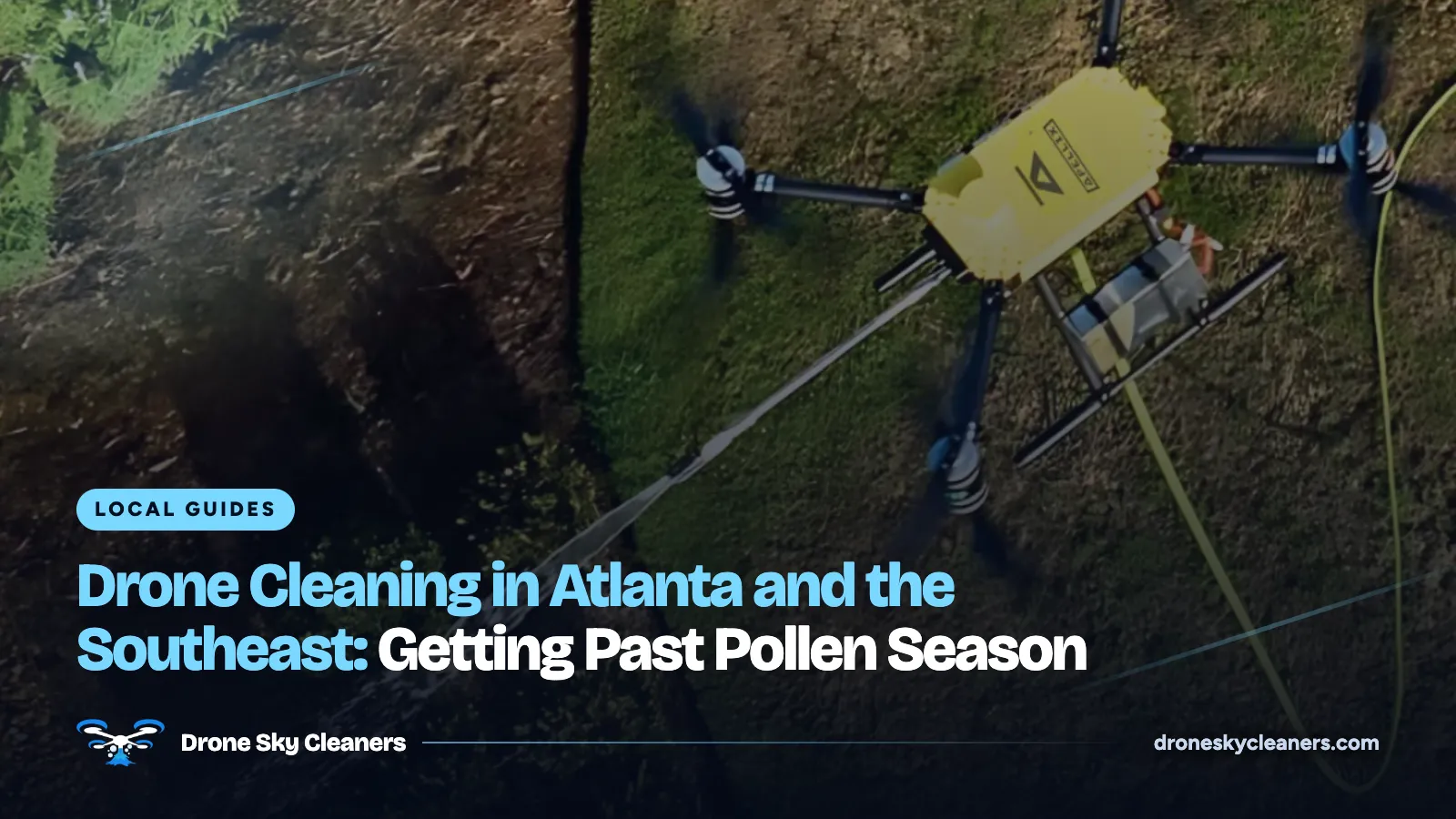
Drone cleaning in Atlanta is usually timed for the end of spring pollen season, when a wash removes the yellow pine pollen coating glass and ledges. Later in the year, humidity brings mildew and red clay dust adds staining. Flights near Hartsfield-Jackson and other airports need FAA airspace authorization first.
The yellow weeks
Atlanta is known as a city in a forest, and in spring the forest lets you know. Pine trees release clouds of yellow pollen that settle on cars, sidewalks, ledges and every pane of glass. Oak and other hardwoods follow with their own.
On a building, pollen collects on sills, mullions, canopy tops and balcony floors. A light shower does not remove it. It turns it into a yellow paste that dries in streaks and rings.
It also feeds what comes next. Pollen left on a damp surface is food for mildew, so a building that skips its spring wash often looks worse by midsummer.
When to wash: timing matters more than anything
The common mistake is washing too early. If pine pollen is still falling, clean glass is yellow again within days.
A simple plan for the season:
- Wait until the heavy pine pollen has finished and a rain or two has cleared the air
- Book the date ahead of time, since many buildings want the same weeks
- Include ledges, canopies and entrance glass, where pollen piles up
- Ask for a backup date, because spring storms are frequent
- Plan a second visit for late summer or fall if mildew is a problem
Red clay dust
Georgia and the Carolina Piedmont sit on red clay. Any nearby construction, and there is a lot of it around Atlanta, Charlotte and Raleigh, puts fine orange dust into the air.
Rain splashes clay onto the lower walls of buildings and leaves a rust-colored band along the base. On light stucco, painted concrete and pale brick it shows clearly.
Fresh clay dust on glass and metal washes off well. Clay that has soaked into porous masonry is harder. It may lighten instead of disappearing, and it can take a second pass. A pre-inspection will say what is realistic.
Humidity, mildew and shaded walls
Summers across the Southeast are hot and humid, with frequent afternoon storms. Shaded walls stay damp, and tree cover keeps the sun off many buildings for much of the day.
Mildew and algae show up as black and green staining on north walls, under eaves, on parking decks and on roofs. Apartment communities with vinyl or fiber cement siding and wooded grounds get it heavily.
A soft wash handles this. A safe cleaning solution breaks down the growth and a deionized water rinse carries it away. No high pressure is driven into siding or mortar.
Charlotte, Raleigh and Nashville
The same pattern holds across the region, with local differences. Charlotte's Uptown has a tight cluster of glass towers near a major airport. Raleigh and the Research Triangle are spread out, with office parks and campuses set among pines, so pollen is heavy there. Nashville has a fast-growing downtown with many new towers and construction dust to match.
Building types vary as well. Downtown, Midtown and Buckhead in Atlanta are mostly glass and precast towers. The suburbs are low-rise offices, retail centers, warehouses and large apartment communities, where roofs and siding matter as much as windows.
In each city, spring is pollen season, summer is mildew season, and fall is often the calmest time for exterior work.
Airspace near Hartsfield-Jackson and other airports
Commercial drone work in the United States is flown under FAA Part 107, with a certified remote pilot, a registered drone and authorization in controlled airspace near airports.
Hartsfield-Jackson lies south of downtown Atlanta and its controlled airspace covers a wide area. DeKalb-Peachtree, Fulton County and Dobbins Air Reserve Base in Marietta add their own zones, so Buckhead, Midtown and the northern suburbs each need checking. Charlotte Douglas, Raleigh-Durham and Nashville International all sit close to their cities.
Authorization is usually requested through LAANC. Rules change, so operators must check the current rules for each address.
Requesting a quote
Drone Sky Cleaners takes requests in Atlanta and across the Southeast. Work is carried out by its own crews or a local Drone Sky franchise partner. Quotes are priced per building after looking at its height, glass area and access.
Mention tree cover, nearby construction and which walls stay shaded, since those decide how much pollen, clay and mildew a building collects. Each job runs through pre-inspection, flight planning, cordoning off the area below, cleaning, final inspection and before-and-after photos, then booking the next clean.
Related pages
- Drone Cleaning Company Atlanta
- Drone Cleaning Company Georgia
- Drone Cleaning Charlotte
- Drone Cleaning Raleigh
- Drone Cleaning Nashville
Common questions
Should I wash my building before or after pollen season?
After, in most cases. Washing while pine pollen is still falling means the glass is coated again within days. Waiting until the heavy drop has passed gives a clean that lasts into summer. Book the slot early.
Will a drone wash remove red clay stains?
It removes clay dust from glass, metal and sealed surfaces well. Stains that have soaked into porous brick, stucco or concrete may only fade and can need a second pass. The pre-inspection will identify which areas are likely to respond.
Does pollen damage windows if it is left on?
Pollen itself is mostly a nuisance. The trouble is what it does when wet. It forms a sticky layer that holds dirt and feeds mildew on frames, seals and ledges. Clearing it after the season keeps that from building up.