
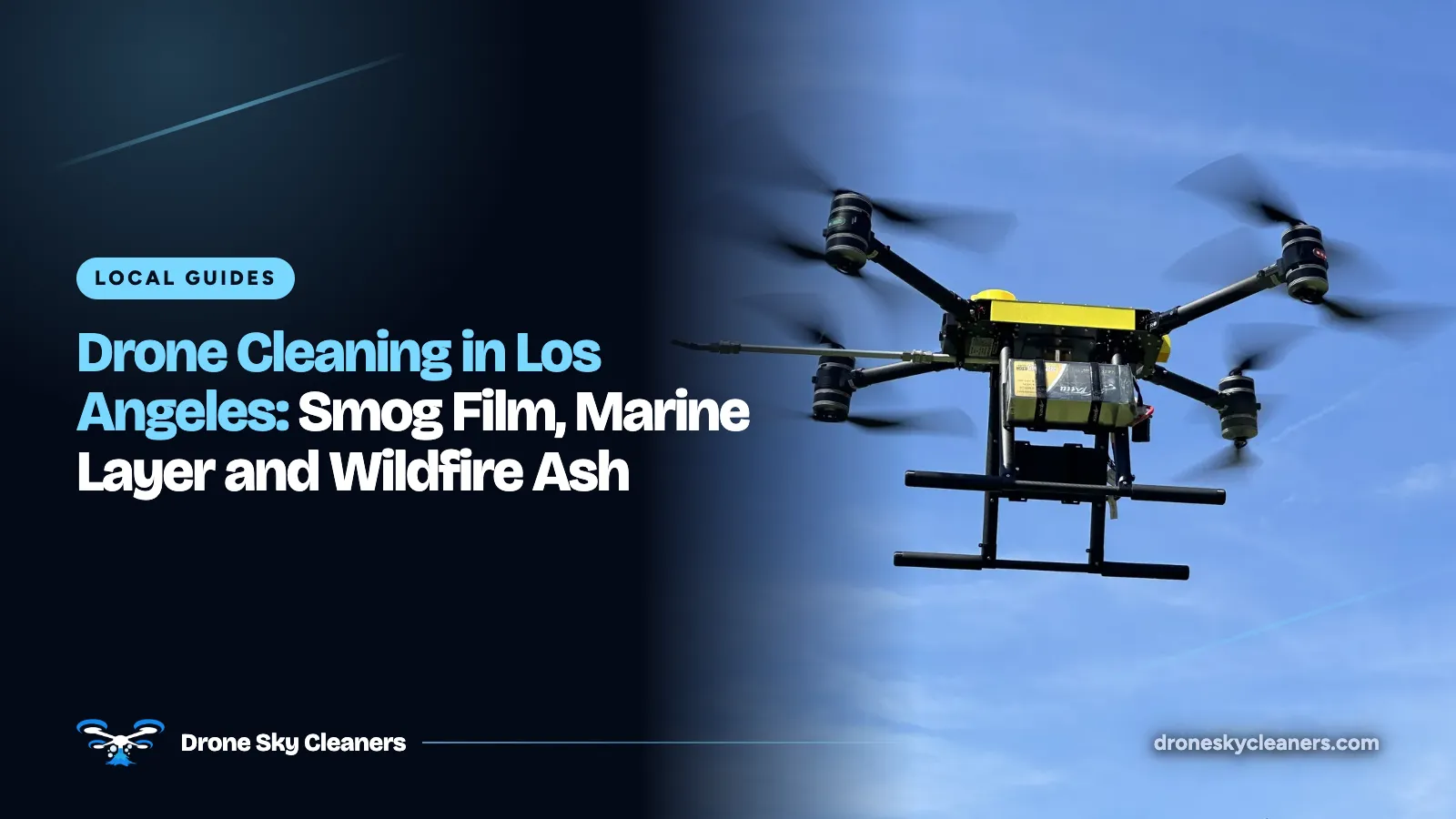
Drone cleaning in Los Angeles removes the smog film, salt haze and wildfire ash that collect on glass and facades during long dry months. A drone washes with deionized water and a safe cleaning solution while the pilot stays on the ground. Flights near LAX, Burbank and Long Beach need FAA airspace authorization.
A city that does not get rinsed
Los Angeles has a long dry season. For months at a stretch, almost no rain falls. That is pleasant for people and hard on buildings, because nothing washes the dust away.
Whatever lands on a facade stays there and bakes in the sun. Layer follows layer. When the first rain of the season does arrive, it often makes things look worse, turning months of dust into streaks down the glass.
So in Los Angeles, the washing has to be planned. The weather will not do it for you.
Smog film and freeway grime
The basin is ringed by mountains that hold air in place, and it carries heavy traffic all day. Exhaust particles, tire dust and road grit settle on every surface.
The result is a fine, slightly oily gray film. Dry dusting does not shift it, and plain water tends to smear it. A safe cleaning solution loosens the film, and a rinse with deionized water carries it off and dries without spots.
Buildings beside the freeways, around Downtown, along the Wilshire corridor and near the ports usually collect it fastest. Lower floors and parking structures take the heaviest load.
Marine layer on the coast side
In late spring and early summer, a low gray cloud deck rolls in from the Pacific most mornings and burns off by afternoon. Locals know it well.
That damp air carries a little salt. It wets the glass each morning, the sun dries it each afternoon, and a hazy deposit is left behind. Dust sticks to the damp surface and the film thickens. Santa Monica, Venice, Marina del Rey, the South Bay and Long Beach see this most.
The marine layer also affects flying. A pilot needs to see the drone and the wall clearly, so coastal jobs often start once the cloud has lifted off the upper floors.
Wildfire ash needs a gentle hand
When fires burn in the hills, ash drifts across the basin and settles on roofs, ledges, solar panels and glass. Dry Santa Ana winds can carry it a long way.
Ash is gritty. Wiping it dry can scratch glass and coatings, and when it gets damp it can turn mildly caustic on some finishes. The safer approach is to float it off with plenty of water and no scrubbing, which is how a drone wash works.
A few points for the weeks after a fire:
- Wait until the air has cleared, or fresh ash will land on clean glass
- Expect ledges, sills and roofs to hold more ash than the glass does
- Heavy deposits may need a second pass
- Ask about roof and solar panel rinsing in the same visit
Water care in a dry region
Water use is a fair question in Southern California. Local agencies set watering and washing rules that tighten in drought years, and storm drains here lead to the ocean, so what goes down them matters.
A drone wash applies water in a controlled spray directly onto the surface instead of flooding it. Purified water rinses clean without repeated passes on normal soiling, and the cleaning solution is chosen to be safe for the building and its surroundings.
Before a job, ask how runoff will be managed at ground level and whether any local water restrictions apply to your address at that time of year.
Airspace near LAX, Burbank and Long Beach
Commercial drone work in the United States is flown under FAA Part 107, with a certified remote pilot, a registered drone and authorization in controlled airspace near airports.
The Los Angeles area has many airports close together. LAX, Hollywood Burbank and Long Beach are the big ones, and Santa Monica, Van Nuys and Hawthorne add more controlled airspace. Helicopters are common over the whole basin. Authorization is usually requested through LAANC, and altitude limits vary block by block. Rules change, so operators must check the current rules for each site.
Getting a quote in Los Angeles
Drone Sky Cleaners takes requests in Los Angeles. Work is carried out by its own crews or a local Drone Sky franchise partner. Quotes are priced per building after looking at its height, glass area and access.
Mention how close you are to the coast or a freeway, and whether ash has been a problem. Every job includes pre-inspection, flight planning, cordoning off the area below, cleaning, final inspection and before-and-after photos.
Related pages
- Drone Cleaning Los Angeles
- Drone Cleaning California
- Drone Cleaning San Diego
- Highrise Drone Cleaning
- Exterior Drone Cleaning
Common questions
When is a good time of year to wash a building in Los Angeles?
Washing is possible most of the year because freezing weather is not a concern. Many owners book once the spring marine layer eases and again in fall. After a fire or a windy dust event, an extra rinse is often worth requesting.
Can a drone remove wildfire ash from windows and roofs?
Yes, in most cases. The drone rinses ash away with water instead of rubbing it across the surface, which lowers the risk of scratching. Thick or baked-on deposits can need a second pass, and the pre-inspection will flag that.
Is drone cleaning allowed near LAX?
It depends on the exact address and height. Flights in controlled airspace need FAA authorization, and areas close to runways have low limits or no approval at all. The operator checks this during flight planning before confirming the job.