
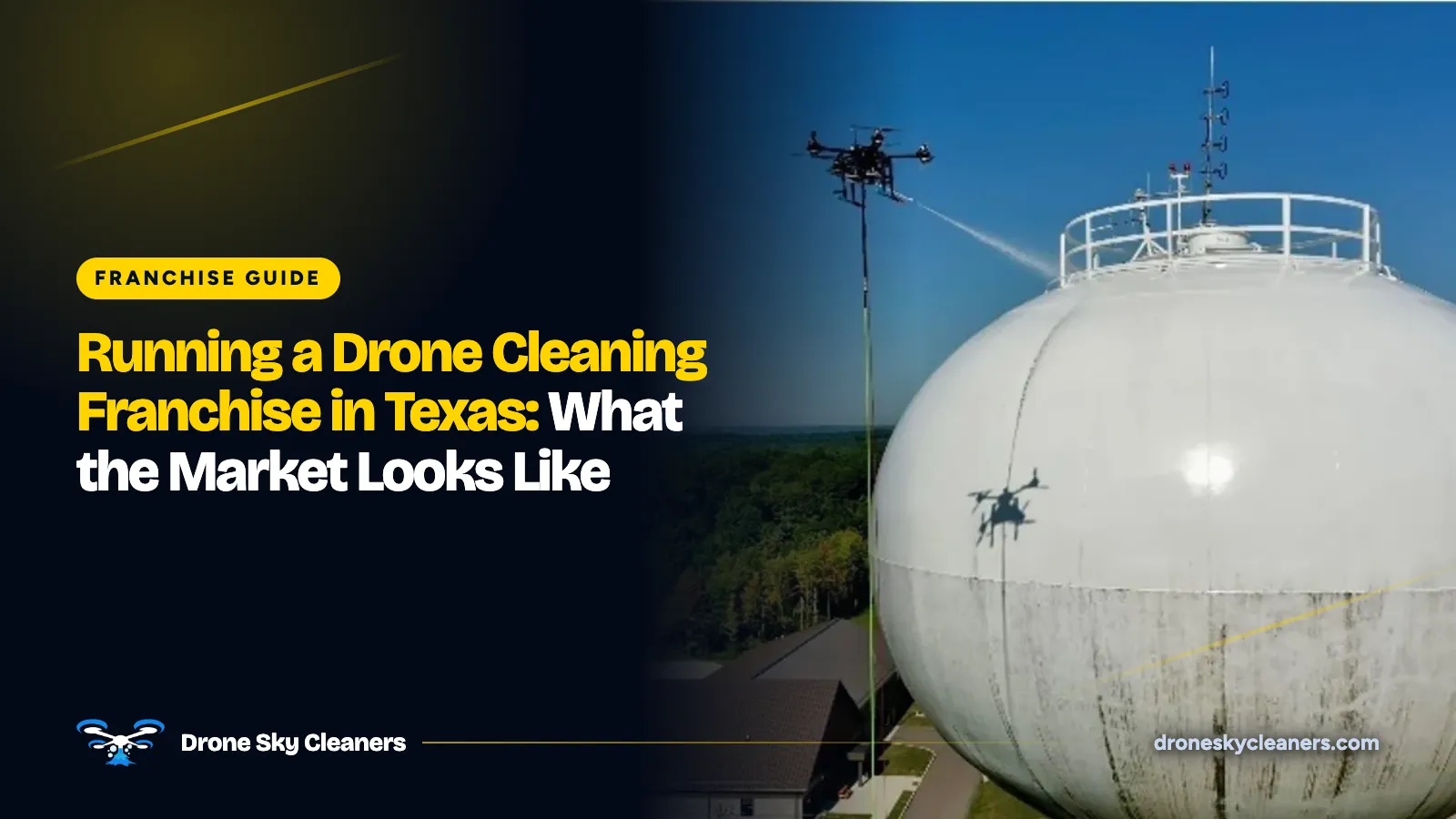
A drone cleaning franchise in Texas works across four large metros: Dallas-Fort Worth, Houston, Austin and San Antonio. Each has glass offices, apartments, hotels and garages. The washing season runs most of the year, with summer flights planned around heat. Texas is not a franchise registration state, so the federal FTC Franchise Rule governs disclosure.
Why Texas is a different kind of market
Most states have one dominant city. Texas has four large metros, each with its own core, its own suburbs and its own property managers. They are hours apart by road, so each one works as a separate market for a local business.
What they share is a lot of glass. Office towers, mid-rise apartments, hospitals, hotels, corporate campuses and parking garages have gone up across the state. Drone Sky Cleaners takes requests in Texas, and work is carried out by its own crews or a local Drone Sky franchise partner.
Dallas-Fort Worth
Dallas-Fort Worth is two downtowns and a wide ring of business districts. Downtown and Uptown Dallas hold the towers. Las Colinas in Irving, the Legacy area in Plano and the corridors through Frisco and Richardson are full of mid-rise offices and corporate campuses with large glass walls.
That spread suits a business that is not limited to towers. A crew might wash an office campus in the morning and a car dealership or retail center in the afternoon. North Texas also gets dust and spring storms, and both leave film on glass.
Houston
Houston has several skylines, not one. Downtown, the Galleria area, the Texas Medical Center and the Energy Corridor each have their own cluster of tall buildings. Hospitals and medical offices are a large part of the building stock.
The Gulf climate shapes the work. Warm, humid air encourages algae and mildew on shaded walls, roofs and parking structures. Industrial sites along the ship channel and the port add another kind of client, with large sheds and high walls that are slow to reach by lift.
Austin and San Antonio
Austin's downtown has filled with residential and office towers, and districts such as the Domain have added mid-rise offices and apartments to the north. Much of the stock is recent, which means post-construction cleaning as well as routine washes.
San Antonio leans toward hotels and hospitality around the River Walk, along with medical and military-related facilities and a wide spread of low and mid-rise buildings. Both cities see heavy pollen in season, including cedar pollen in winter, which coats glass and ledges.
A long season and how heat changes the schedule
Freezing days are few in most of Texas, so washing is possible through most of the year. That is the good news. The catch is summer.
On glass that has been baking in full sun, cleaning solution can dry before it is rinsed and leave marks. Crews handle this by starting at first light, working the shaded side of a building first and stopping before the hottest part of the afternoon. Batteries and people both need shade and rest.
Other weather to plan for:
- Spring thunderstorms and hail in North and Central Texas
- Gulf storms on the coast in late summer and fall
- Strong, gusty winds on the plains and around tall buildings
- The occasional winter cold snap that halts work for a few days
Texas airspace
Commercial drone work is flown under FAA Part 107: a certified remote pilot, a registered drone and authorization in controlled airspace near airports, usually requested through LAANC. Rules change, so operators must check the current rules.
Texas has a lot of airports close to its buildings. Dallas Love Field sits a short distance from downtown Dallas, with Dallas Fort Worth International between the two cities. Houston has George Bush Intercontinental to the north and William P. Hobby to the south. Austin-Bergstrom and San Antonio International are both near their cities' cores. Add military airfields around San Antonio and hospital helipads everywhere, and airspace checks become part of every quote.
Franchise rules in Texas, in general terms
Texas is not one of the franchise registration states. The federal FTC Franchise Rule still applies. A franchisor must give you a Franchise Disclosure Document at least 14 days before you sign or pay. States can have other filing requirements, so ask a franchise attorney how Texas law applies to you. This is general information, not legal advice.
The Drone Sky path has three steps: submit an application, go through an approval process focused on operational and safety standards, and launch with guidance. Investment details are shared with applicants.
Related pages
- Drone Cleaning Franchise
- Drone Cleaning Franchise Texas
- Drone Cleaning Franchise Dallas
- Drone Cleaning Franchise Houston
- Drone Cleaning Franchise Austin
Common questions
Can drone cleaning run all year in Texas?
In most of the state, yes, with pauses. Summer heat moves work to early morning, spring storms and Gulf weather cancel days, and a rare freeze stops washing briefly. Owners plan the calendar around those patterns instead of a long winter shutdown.
Which Texas metro is right for a drone cleaning franchise?
There is no single answer. Each metro has a different mix of towers, mid-rises, hospitals, hotels and industrial sites. The one you know well, where you can reach property managers in person, is usually the sensible place to start the conversation.
Do I need special approval to fly near Texas airports?
Flights in controlled airspace near airports need FAA authorization, which is usually requested through LAANC. Many central districts in Texas cities fall inside that airspace. Check each address ahead of time, because requirements differ by location and they change.