
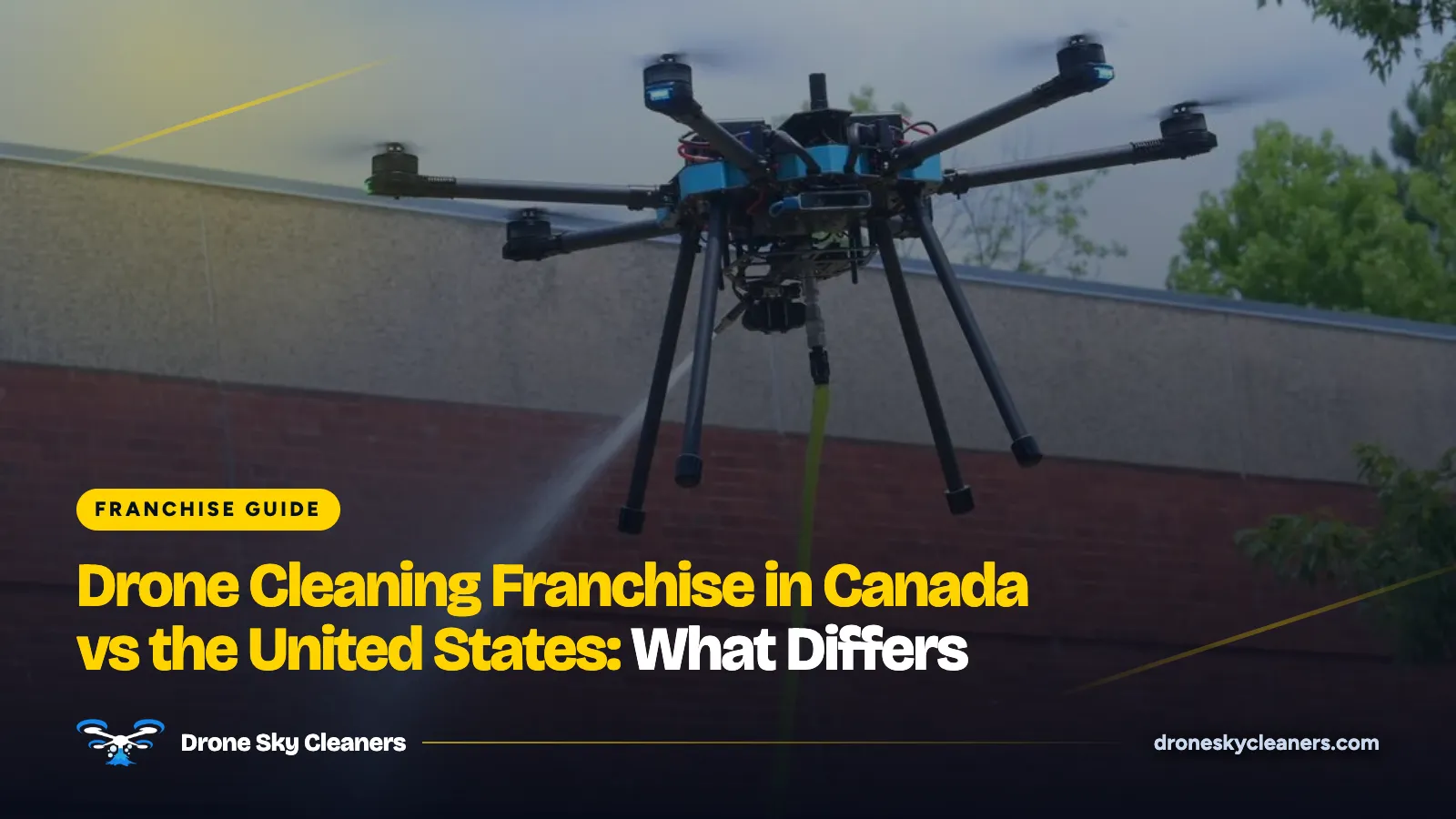
A drone cleaning franchise works the same way on site in Canada and the United States. Three things differ. Flights follow Transport Canada rules in Canada and FAA Part 107 in the United States. Most Canadian cities have a shorter season. Franchise disclosure is set by several provinces in Canada and by federal and state law south of the border.
What stays the same
Stand on a sidewalk in Toronto or in Chicago and a drone cleaning job looks identical. The drone washes with deionized water and a safe cleaning solution while the pilot stays on the ground. The steps are the same: pre-inspection, flight planning, cordoning off the area below, cleaning, final inspection, before-and-after photos and booking the next clean.
Drone Sky Cleaners takes requests across Canada and the United States, and work is carried out by its own crews or a local Drone Sky franchise partner. The differences are in the rules that surround the work, the calendar and the paperwork of buying a franchise.
Flight rules: Transport Canada and the FAA
Each country has its own aviation regulator and its own system.
In Canada, drones are regulated by Transport Canada under its drone (RPAS) rules. Commercial cleaning work calls for a certified pilot, a registered drone and airspace clearance where needed.
In the United States, commercial drone work is flown under FAA Part 107. That means a certified remote pilot, a registered drone and authorization in controlled airspace near airports, usually requested through LAANC.
The broad shape is similar, but the certificates, registrations and approval processes are separate. A pilot certificate from one country does not by itself allow commercial flying in the other. Rules change in both countries, so operators must check the current rules where they fly.
Season length
Drones wash on calm, dry days above freezing. That one sentence explains most of the calendar gap between the two countries.
Most Canadian cities have a real winter. In Toronto, Calgary, Ottawa and Montreal, freezing temperatures shut down washing for a good part of the year. Work is concentrated between spring and fall, and owners plan for that.
The United States has both kinds of market. Minneapolis, Chicago and Boston have winters much like Toronto's. Phoenix, Houston and Miami can wash in every month, with heat and storms as the limits instead of ice. Vancouver is Canada's exception, with a mild coastal climate closer to Seattle's.
City examples side by side
Pairing cities across the border shows how alike some markets are.
- Toronto has a deep stock of condo and office towers, cold winters and an island airport right beside downtown. Chicago is a fair comparison: a lakefront wall of towers and a hard winter.
- Vancouver has glass residential towers, a rainy mild winter and floatplanes and helicopters using the harbor next to downtown. Seattle shares the climate, the moss and algae on shaded walls and the busy waterfront airspace.
- Calgary has a compact tower core, dry air, dust and winter warm spells from chinook winds that can open short working windows. Denver is similar: sunny, dry, windy at times and close to the mountains.
Airports and airspace
Both countries require clearance to fly in controlled airspace, and big-city cores often sit inside it. Toronto has its island airport and Pearson to the west. Vancouver International lies just south of the city, with harbor traffic downtown. Calgary's airport is in the city's northeast.
American cities have the same pattern, with airports close to downtown in places such as San Diego, Phoenix and Boston. On either side of the border, the airspace check comes before the quote date is promised.
Franchise law on each side
This part is general education, not legal advice.
In the United States, the federal FTC Franchise Rule requires a franchisor to give a buyer a Franchise Disclosure Document at least 14 days before the buyer signs or pays. Some states go further and require franchisors to register before selling.
Canada has no single national franchise statute. Several provinces have their own franchise laws, and those laws generally require a franchisor to give a buyer a disclosure document before the buyer signs or pays. The details differ by province.
Wherever you are, the practical step is the same. Hire a franchise lawyer in your own province or state to review the documents before you commit.
The path is the same in both countries
Becoming a Drone Sky franchise partner takes three steps: submit an application, go through an approval process focused on operational and safety standards, and launch with guidance. Investment details are shared with applicants.
Tell the team which city you have in mind. The buildings, the season and the airspace in that place will shape the conversation more than the border does.
Related pages
- Drone Cleaning Franchise
- Drone Cleaning Franchise Canada
- Drone Cleaning Franchise Toronto
- Drone Cleaning Franchise Vancouver
- Drone Cleaning Franchise Calgary
Common questions
Can one franchise owner work on both sides of the border?
Each country has its own pilot certification, drone registration and airspace rules, along with customs, tax and business requirements. Territory is discussed with applicants. In practice, an owner builds a business in one local market and follows that country's rules.
Is the winter shutdown in Canada a problem for owners?
It is a planning matter. Exterior washing pauses when temperatures stay below freezing, so the work is concentrated in the warmer months. Northern owners in both countries use winter for quotes, site visits, equipment care and preparing the next season's schedule.
Are drone rules stricter in Canada or the United States?
They are different systems and hard to rank. Both require a certified pilot, a registered drone and clearance for controlled airspace. What matters is following the current rules of the country you fly in, since both sets change over time.