
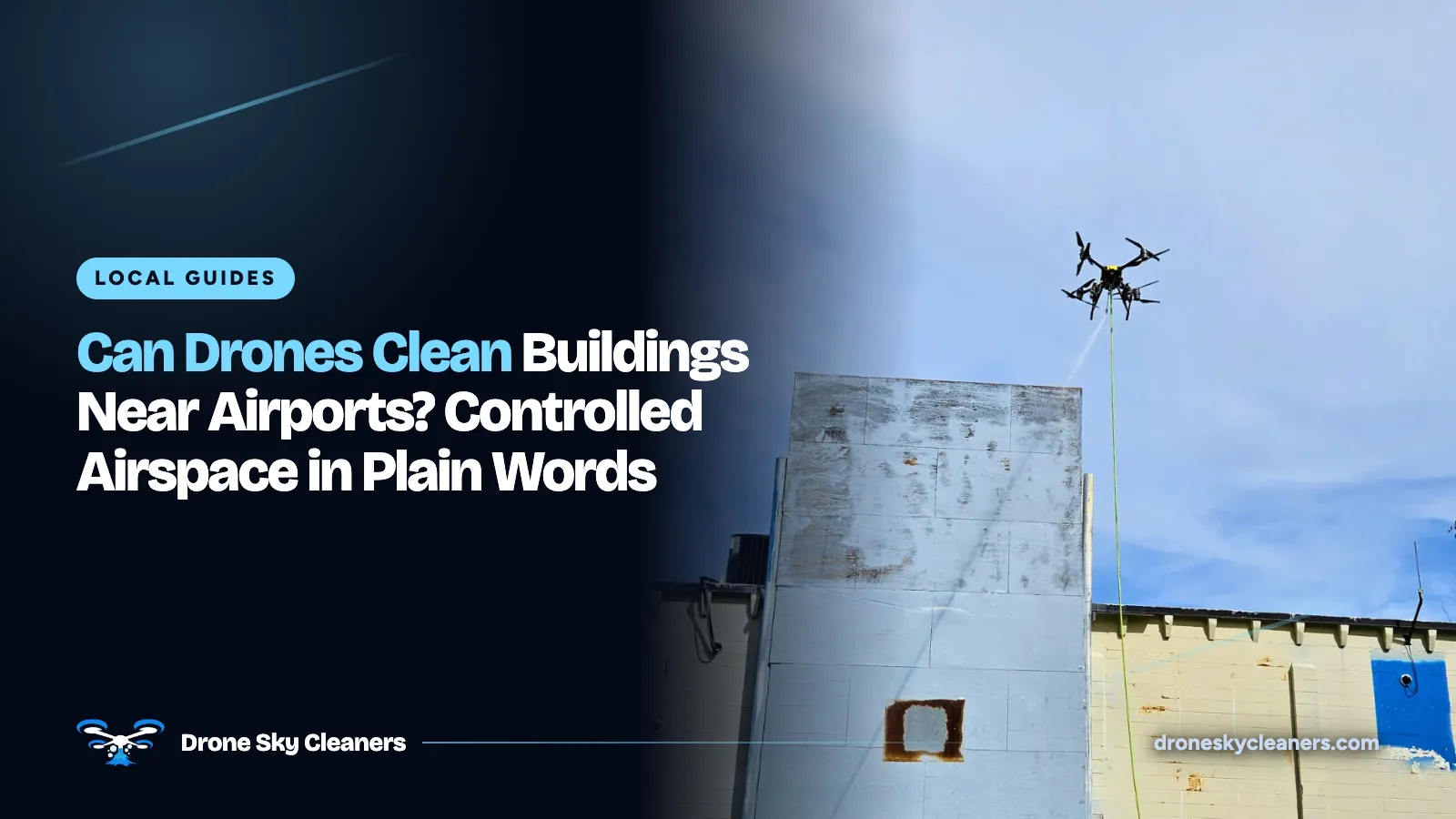
Yes, drones can often clean buildings near airports, but only with FAA authorization for that location. In the United States the operator usually requests it through a system called LAANC, which can approve many low flights quickly. Sites very close to runways may need a longer review, and a few cannot be flown at all.
The short version
Being near an airport does not automatically rule out drone cleaning. It adds a permission step. The operator has to ask the FAA before flying, and the answer depends on exactly where your building stands and how high the drone needs to go.
Many city centers sit inside this kind of airspace, so professional operators deal with it routinely.
What controlled airspace means
Around busy airports, air traffic control manages the sky from the ground up. This is called controlled airspace. It exists so controllers know what is flying near arriving and departing aircraft.
Commercial drone work in the United States is flown under FAA Part 107. That requires a certified remote pilot and a registered drone. Inside controlled airspace, it also requires authorization before the flight.
The shape of this airspace is not a neat circle. It follows runways and approach paths, so two buildings the same distance from an airport can have very different limits.
How LAANC works
LAANC stands for Low Altitude Authorization and Notification Capability. It is the FAA's system for handling drone requests near airports, and operators reach it through approved apps.
The FAA has divided the area around each participating airport into a grid. Every square has a ceiling, the highest a drone can be approved to fly there without extra review. Squares far from the runways tend to have higher ceilings. Squares close in have lower ones, and some are set to zero.
- If the job fits under the ceiling for that square, approval can come back almost at once.
- If the building is taller than the ceiling, the operator files a request for further review, which takes longer and may be declined.
- If the square is set to zero, any flight needs that longer review.
- Not every airport is in LAANC. For those, requests go through a separate FAA process.
City examples
Some cities have airports almost downtown, and the effect on buildings is easy to see.
Rules change, and operators must check the current rules and the current map for each address.
- New York: LaGuardia, JFK and Newark surround the city, and heliports line the rivers. Much of the city sits in controlled airspace, and New York City also has its own local permit rules for taking off and landing a drone.
- Chicago: O'Hare and Midway sit on opposite sides of the city. Buildings on the approach paths face tighter limits than the lakefront does.
- Las Vegas: the main airport sits right next to the Strip, so resort towers there are among the closest tall buildings to a major runway anywhere.
- San Diego: the airport is beside downtown, and aircraft descend low over nearby neighborhoods on approach. A naval air station sits across the bay.
- Boston: Logan is just across the harbor from downtown and the Seaport, so waterfront towers are well inside its airspace.
What to expect on timing
For most buildings, the airspace step is invisible to you. The operator checks your address during planning and gets approval before the crew arrives.
For tall buildings close to a runway, plan for more lead time. A request for further review is handled by people at the FAA, not by software, and the reply can take weeks. The approval may also come with conditions, such as a height limit or set hours.
Be ready for an honest no. If the airspace above your roof cannot be approved, a drone cannot wash the upper floors, and a good operator will tell you that at the start.
How Drone Sky Cleaners handles it
Airspace is checked as part of flight planning, right after the pre-inspection. Then the job follows the usual steps: cordoning off the area below, cleaning with deionized water and a safe cleaning solution, final inspection and before-and-after photos.
Drone Sky Cleaners takes requests across Canada and the United States, and work is carried out by its own crews or a local Drone Sky franchise partner. In Canada the same idea applies under Transport Canada's drone rules, with airspace clearance where needed. Quotes are priced per building after looking at its height, glass area and access. Give your full street address when you ask, since the airspace answer starts there.
Related pages
- Highrise Drone Cleaning
- Drone Cleaning New York
- Drone Cleaning Chicago
- Drone Cleaning Las Vegas
- Drone Cleaning San Diego
Common questions
How do I know if my building is in controlled airspace?
You do not have to work it out yourself. Give the operator your exact address and building height, and they can check it against the FAA's maps. Being close to a commercial airport or a military airfield is the usual sign.
Does the building owner need to apply for the FAA authorization?
No. The drone operator applies, since the authorization is tied to the pilot and the flight. Your part is to provide accurate details about the building and to allow enough time before the date you want.
What if only part of my building can be approved?
Sometimes the approved height covers the lower floors but not the top. In that case the drone can wash what is permitted, and the remaining floors need another access method or a later request to the FAA.